
AEM Releases 2025 U.S. Lightning Report: Oklahoma Dethrones Florida as America’s Lightning Concentration Capital
Historic Shift as Great Plains Emerges as New Epicenter of Severe Storm Activity
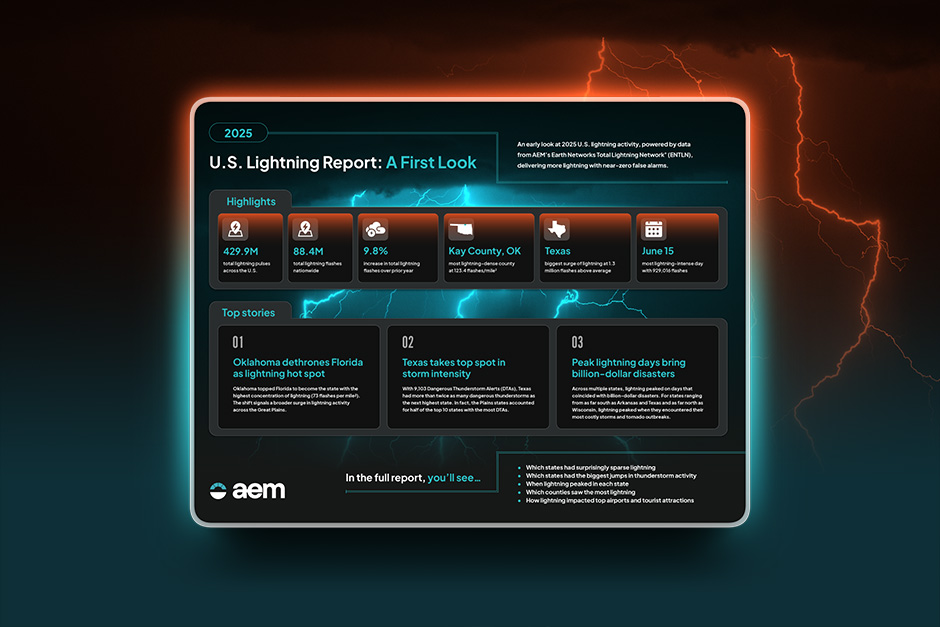
GERMANTOWN, MD, January 5, 2026 — AEM, the essential source for environmental insights, today released its 2025 U.S. Lightning Report, revealing that Oklahoma has dethroned Florida to become the nation’s lightning concentration capital. With approximately 73 flashes per square mile, Oklahoma displaced the state that has traditionally dominated this ranking, signaling a broader surge in lightning activity across the Great Plains.
Overall, AEM’s Earth Networks Total Lightning Network® detected nearly 430 million lightning pulses within 88.4 million lightning flashes across the U.S. in 2025, a 9.8% increase from the prior year.
While Oklahoma led in lightning concentration, Texas dominated in sheer volume and storm intensity. The state recorded more than 13 million lightning flashes, exceeding its historical average by 1.3 million. As an additional indicator of storm severity derived from lightning behavior, Texas also registered the highest number of Dangerous Thunderstorm Alerts (DTAs), a proprietary AEM metric that flags periods of exceptionally intense lightning rates associated with severe storms and provides an early signal of rapidly intensifying thunderstorm activity. Overall, the Great Plains accounted for roughly half of the top 10 states with the most intense lightning storms, underscoring the region’s reputation as a severe weather hotspot.
“Oklahoma’s rise to the top of our lightning rankings represents a significant shift in 2025’s weather patterns compared with past years,” said Dr. Elizabeth DiGangi, a lightning scientist at AEM. “Because ENTLN captures lightning activity with exceptional coverage and precision, we can see how lightning patterns are evolving, with the Great Plains emerging as an increasingly active region for high-impact storms.”
Dr. Elizabeth DiGangi
Lightning Scientist, AEM
Key Findings from the 2025 Report
- Top States by Flash Density: Oklahoma claimed the top position with 73 flashes per square mile, followed by Florida, Louisiana, and Kansas.
- Top County by Flash Density: Kay County, Oklahoma, led the nation with 123.4 flashes per square mile.
- Peak Lightning Day: June 15 was the most lightning-intense day of the year with 929,016 flashes recorded nationwide.
- Airport Impacts: Hartsfield-Jackson Atlanta International Airport, the world’s busiest airport, contended with more than 10,000 lightning flashes. Eight of the 10 busiest U.S. airports experienced their peak lightning day during the height of summer travel season.
- Tourist Landmark Exposure: Chicago’s Millennium Park was exposed to more than 11,000 lightning flashes, more than any other top-visited U.S. landmark. Half of the nation’s most-visited landmarks experienced peak lightning between June and August, when visitor traffic is highest.
- Stadium Exposure: Among the nation’s 10 largest stadiums by seating capacity, the three with the highest lightning exposure were Tiger Stadium, Kyle Field, and the Cotton Bowl, all SEC venues. Neyland Stadium experienced its peak lightning on September 4, within days of hosting the University of Tennessee’s second football game of the season.
The report also documents a troubling correlation between peak lightning days and billion-dollar disasters. Arkansas experienced its highest lightning activity on April 2, coinciding with a devastating tornado outbreak. Wisconsin’s peak on May 15 marked the start of a billion-dollar tornado and storm event. Texas recorded its peak lightning day on May 26 at the intersection of two separate billion-dollar disasters.
Data for the 2025 report was captured by AEM’s Earth Networks Total Lightning Network (ENTLN), the world’s most comprehensive global lightning detection network. ENTLN’s more than 1,800 sensors provide real-time detection and analysis that helps organizations better understand lightning risk and storm evolution.
The 2025 U.S. Lightning Report can be found here.
About AEM
AEM is combining global technology leaders to empower communities and organizations to survive and thrive in the face of escalating environmental risks. By deploying intelligent sensing networks, operating a secure and scalable data management infrastructure, and delivering high-value analytics through a suite of end-user applications, AEM serves as the essential source for environmental insights. These technologies enable positive outcomes, helping reduce environmental impact and creating a safer world. For more information, visit https://aem.eco.