
Earth Networks Total Lightning Network®
AEM’s global total lightning detection network is built for accuracy and trust. High-quality data, precise locations, and dependable performance support critical decisions worldwide.
- Deliver more complete in-cloud and cloud-to-ground lightning data
- Maintain high data quality with near-zero false alarm rate (<0.25%)
- Precisely locate lightning with <100 m accuracy

- What to know
- Reliable data
- Accurate detection
- Real-time delivery
- Related products

The first total lightning network
At AEM, we pioneered total lightning as the first innovator to accurately detect and classify both in-cloud and cloud-to-ground lightning, capturing the full electrical structure of storms.

Built for critical decisions
Designed with strict quality controls to deliver high-volume lightning data that can be used confidently in safety and operational settings.

Trusted around the world
Used by public safety agencies, government organizations, data partners, and industry to manage lightning risk across regions and worldwide.
Reliable lightning data you can trust
Lightning data only adds value when it’s accurate and consistent. ENTLN is designed to detect more lightning without introducing noise, using strict quality controls to ensure detections reflect real storm activity, not interference or artifacts.
Built for accurate lightning detection
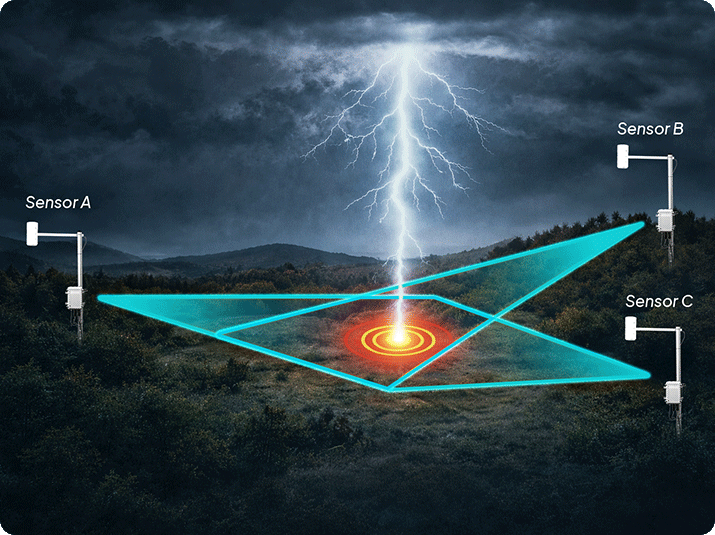
Developed and refined by AEM’s lightning scientists, the Earth Networks Total Lightning Network uses time-of-arrival measurements across multiple sensors to accurately locate lightning worldwide. Regional processing optimizes detection of both in-cloud and cloud-to-ground lightning using direct measurements.
The result is >95% classification accuracy, <100 m global location accuracy, and up to 95% detection efficiency (depending on sensor density).
Fast access to lightning data around the globe
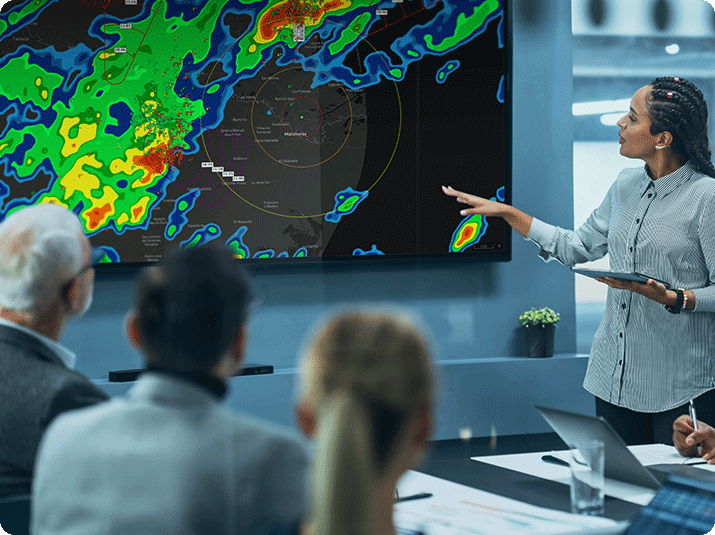
ENTLN delivers lightning data quickly and consistently to support time-sensitive decisions as storms evolve. Data is processed and delivered globally in seconds, with 99.9% uptime to ensure reliable data delivery during active weather.
Lightning data from ENTLN is delivered through APIs, data feeds, and AEM software, supporting developers, forecasters, emergency managers, and operational teams.
Discover products powered by the Earth Networks Total Lightning Network
AEM Elements® 360
AEM Elements 360 is a multi-hazard weather intelligence solution and the cornerstone of the Elements Resiliency Platform.
View more
Sferic Maps®
The ultimate severe weather visualization, decision support, and alerting tool, with a vast library of weather observation layers.
View more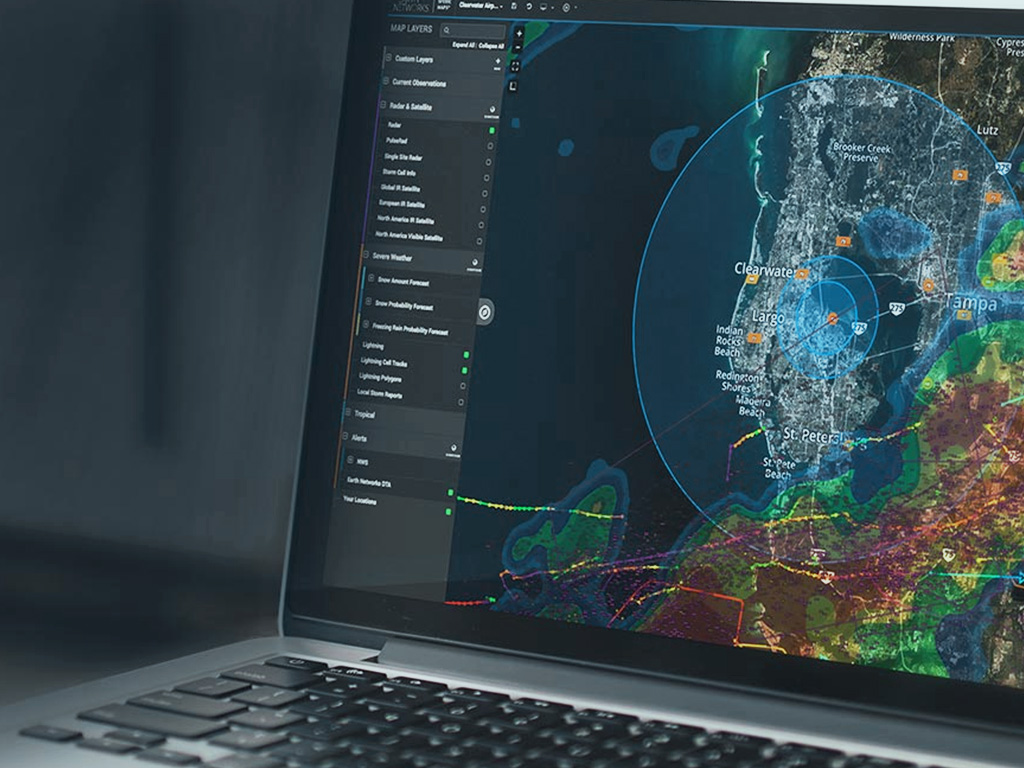
Sferic Siren Lightning Alert System
Make sure everyone knows lightning is on the way with our automated outdoor alert system.
View more
Lightning Sensor
Our lightning sensors capture in-cloud and cloud-to-ground lightning in real time with unbeatable accuracy.
View more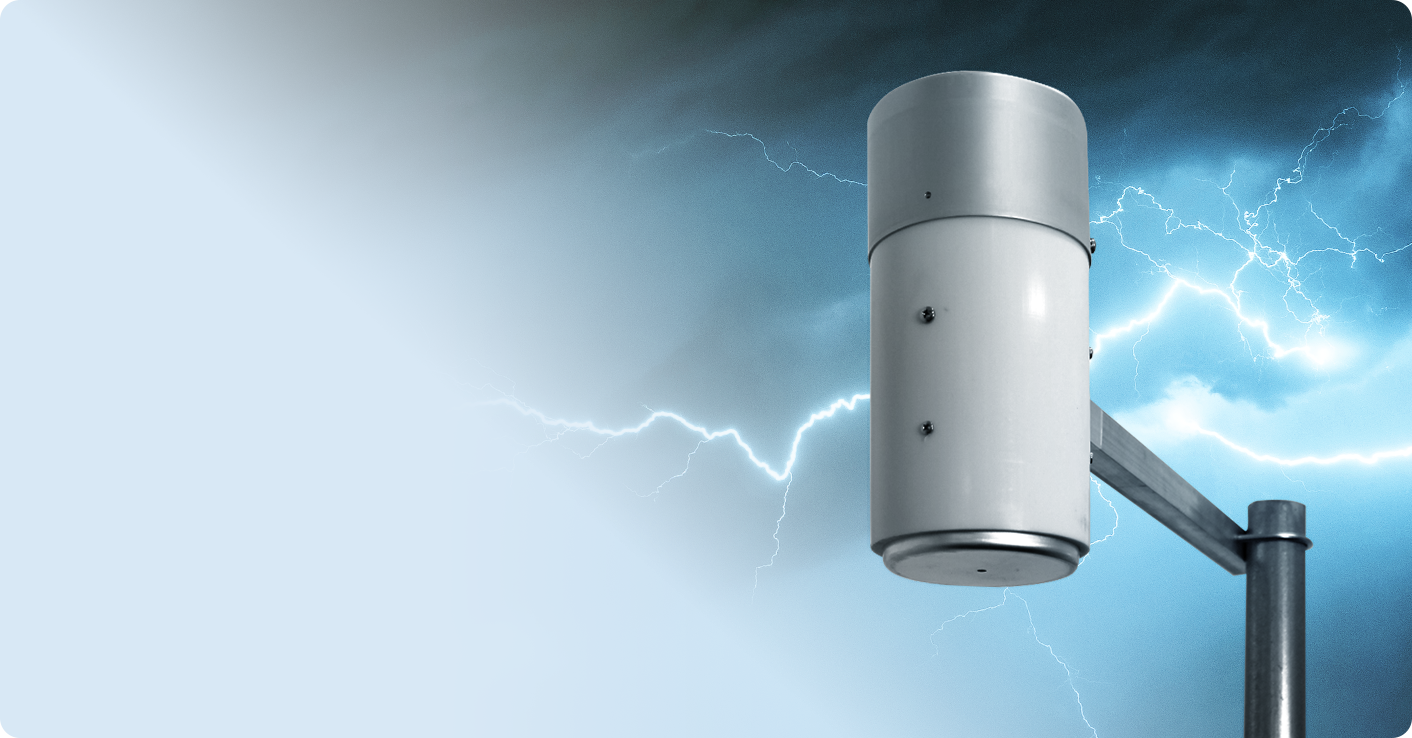
Dangerous Thunderstorm Alerts
Get up to 45 minutes of lead time to prepare for fast-moving, dangerous storms.
View more

See how your lightning risk measures up
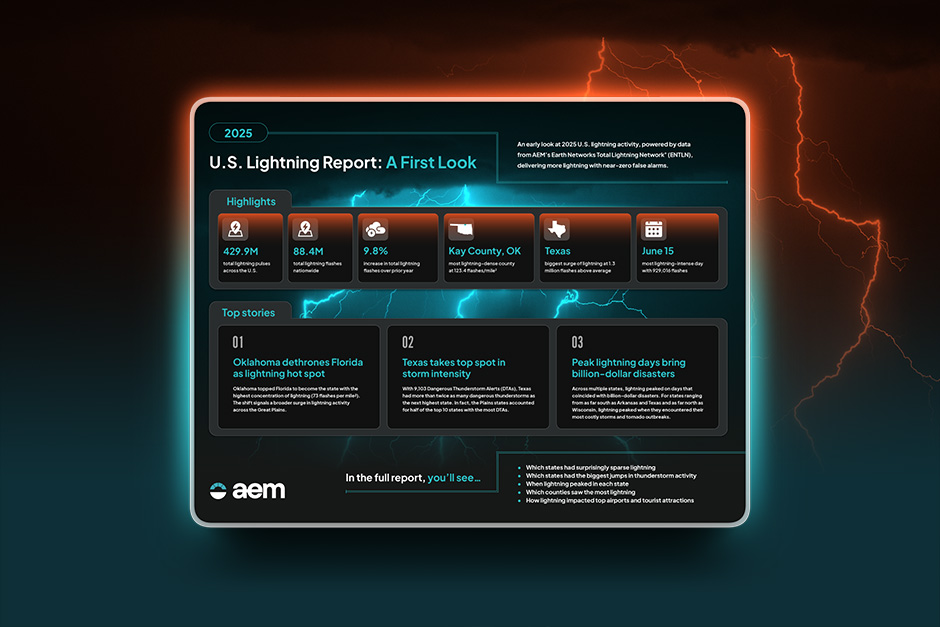
Powered by the ENTLN, AEM’s 2025 U.S. Lightning Report delivers top stories, deep insights, and comprehensive observations of lightning activity for every state and county. Plus, get bonus data for top airports, outdoor venues, and tourist destinations.


Waco-McClennan County Office of Emergency Management
“We’re using it not only for those special [outdoor] events, but also for community centers that have pools… setting up lightning rings around those pools and sending alerts for close lightning strikes directly to our parks and rec partners.”
Ryan Dirker
Emergency Management Coordinator



Research & Validation Studies
Detection and Location Performance
- Zhu et al. (2022). Upgrades of the Earth Networks Total Lightning Network in 2021
- Sonnenfeld et al. (2020). Earth Networks Lightning Network Performance
- Zhu et al. (2017). Evaluation of ENTLN Performance Characteristics Based on the Ground Truth Natural and Rocket-Triggered Lightning Data Acquired in Florida
- Mallick et al. (2015). Performance Characteristics of the ENTLN Evaluated Using Rocket-Triggered Lightning Data
- Liu and Heckman (2012). Total Lightning Data and Real-Time Severe Storm Prediction
Network Comparisons
- Ringhausen et al. (2024). Inter-Comparison of Lightning Measurements in Quasi-Linear Convective Systems
- Virts et al. (2024). Bayesian Analysis of the Detection Performance of the Lightning Imaging Sensors
- Allen et al. (2021). Observations of Lightning NOx Production From GOES-R Post Launch Test Field Campaign Flights
- Marchand et al. (2019). Geostationary Lightning Mapper and Earth Networks Lightning Detection Over the Contiguous United States and Dependence on Flash Characteristics
- Bitzer et al. (2016). A Bayesian Approach to Assess the Performance of Lightning Detection Systems
- Rudlosky (2015). Evaluating ENTLN Performance Relative to TRMM/LIS
Scientific Applications
- Chaffin et al. (2024). Mountaintop Gamma Ray Observations of Three Terrestrial Gamma-Ray Flashes at the Säntis Tower, Switzerland With Coincident Radio Waveforms
- Lay et al. (2024). Probing the D-region ionosphere globally with Earth Networks Total Lightning Network data
- Van Eaton et al. (2023). Lightning Rings and Gravity Waves: Insights into the Giant Eruption Plume from Tonga’s Hunga Volcano on 15 January 2022
- DiGangi et al. (2022). Analyzing lightning characteristics in central and southern South America
- DiGangi et al. (2022). Thunder Hours: How Old Methods Offer New Insights into Thunderstorm Climatology
- Ringhausen and Bitzer (2021). An Investigation of the Electrification of Hurricane Harvey Using GLM and ENTLN Data
- Liu et al. (2021). Enhanced Lightning Activity in Australia during the 2019–2020 Wildfire Crisis
- Liu et al. (2020). Lightning Enhancement over Major Oceanic Shipping Lanes
- Borque et al. (2020). Distinctive Signals in 1-min Observations of Overshooting Tops and Lightning Activity in a Severe Supercell Thunderstorm
- Prata et al. (2020). Characteristics of thunder and electromagnetic pulses from volcanic lightning at Bogoslof volcano, Alaska
- Yanoviak et al. (2019). Lightning is a major cause of large tree mortality in a lowland neotropical forest
Frequently asked questions
The Earth Networks Total Lightning Network was the first lightning network to accurately measure and classify both in-cloud and cloud-to-ground lightning. In the past, most lightning detection networks only focused on cloud-to-ground strikes. That’s why we say it’s a “total” lightning network.
In-cloud lightning is an indicator of danger for cloud-to-ground lightning in areas where lightning might not be occurring yet. That means that if you only monitor cloud-to-ground lightning, you’re taking a reactive approach to lightning safety rather than a proactive one.
Cloud-to-ground lightning is just what it sounds like: a bolt of lightning shoots between a storm cloud and the earth. This is what most of us think about when we think of “lightning.” In-cloud lightning refers to the electrical activity that happens high above our heads within the storm but never makes it to ground. Typically, storms that produce cloud-to-ground strikes have even more activity occurring within the storm system. The ENTLN delivers the most accurate global lightning classification accuracy of >95%.
ENTLN helps organizations monitor lightning risk and alert the right people quickly. Teams can visualize real-time lightning activity in AEM Elements® 360 or Sferic Maps®, set proximity-based alerts for specific locations, and receive notifications through the application, email, or text.
For locations where people may be outdoors, Sferic Siren Outdoor Alerting System can automatically trigger audible and visual alerts when nearby lightning is detected, helping organizations communicate when people should seek shelter.
The data from an AEM lightning sensor is best viewed within our AEM Elements 360 or Sferic Maps® application. From there, your data can be exported in a variety of sharable formats.
Our lightning sensor’s measurement range is 20km – 400km with an accuracy of <100 meters. That means it can pinpoint a lightning strike nearly 250 miles away to an area with a radius less than two and a half football fields.
GET IN TOUCH
Interested in learning more?
If you have questions about anything you see, fill out the form below. An AEM Weather Expert will reach out to you shortly.