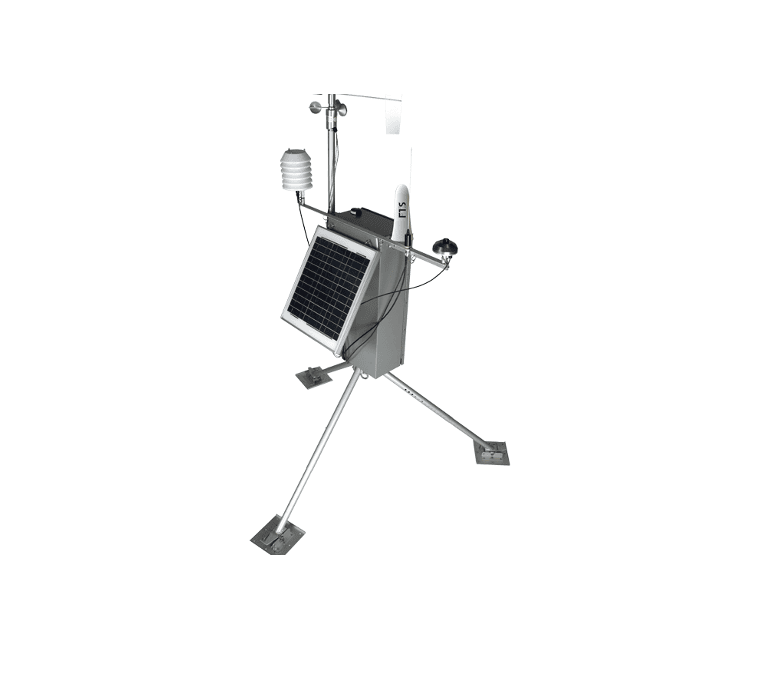

Remote Automated Weather Station (RAWS)
Get exceptionally accurate wildfire weather data. Our Remote Automated Weather Stations are trusted in some of the world’s harshest locations.
Wildland fire agencies around the world rely on weather data to guide how they prepare for and respond to wildfire risk. From staffing levels to resource deployment, conditions on the ground directly influence how they position their teams.
To better align their decisions with real-world conditions, one fire agency in California decided to expand its Remote Automated Weather Station (RAWS) network and introduced a Quick Deploy Remote Automated Weather Station (QD RAWS). This enabled the agency to combine continuous monitoring across its territory with the ability to capture weather data at specific points of need.
“With our RAWS stations, we can accurately reflect the conditions on the ground. This information helps us make better decisions for resource allocation and preparedness.”
This particular agency operates across a landscape where terrain, wind patterns, and localized conditions create meaningful variation in wildfire risk. Supporting effective response requires decisions that reflect those variations across the agency’s territory and at individual incident locations.
Areas with a history of fire activity often face higher risk conditions than the surrounding region.
Weather data from stations miles away may not fully represent what is happening at the fire itself.
Fires occur unpredictably, making it impractical to instrument every area of concern with fixed stations.
Without visibility into localized conditions, staffing levels and resource deployment may not fully align with actual risk.
The agency strengthened its weather monitoring capabilities by expanding its RAWS network and introducing a QD RAWS.
The location for the new RAWS was decided strategically. Drawing on local knowledge of fire behavior and terrain, the team identified an at-risk canyon that would fill a gap in the existing network.
Realizing the impracticality of placing a permanent station in every canyon and confluence, the agency secured a QD RAWS to provide localized data where permanent coverage is not available. As the agency’s Wildland Resource Planner explains, when the fire does not come to the RAWS, teams can “bring the RAWS to the fire.”
 RAWS to strengthen baseline coverage across the county
The agency expanded its network by strategically placing a new permanent station in a high-risk canyon.
 QD RAWS to support real-time incident response
The agency plans to deploy its portable station at incident locations to capture on-site weather conditions and improve decision-making where nearby stations may not reflect actual conditions.
 QD RAWS to support prescribed fire planning
The agency sees potential to inform the timing and execution of prescribed fires by monitoring conditions at prospective burn sites in the weeks ahead.
The agency’s expanded RAWS network and introduction of QD RAWS will give it a more complete picture of conditions across its territory and at individual incident locations. By expanding its ability to monitor localized conditions in real time, the agency can better align its actions with how wildfire risk develops on the ground. The result: improved situational awareness, more informed resource allocation, and greater confidence in how decisions are made before and during wildfire events.